Enterprise workflow · Media operations · Role-based planning

MGM — One Release Plan, Three Decision Views.

MGM needed a strategic release-planning system to coordinate theatrical release decisions across market timing, competitive pressure, financial impact, and operational dependencies. I led the design of a role-based release calendar that gave each stakeholder the view they needed — without fragmenting the system underneath.
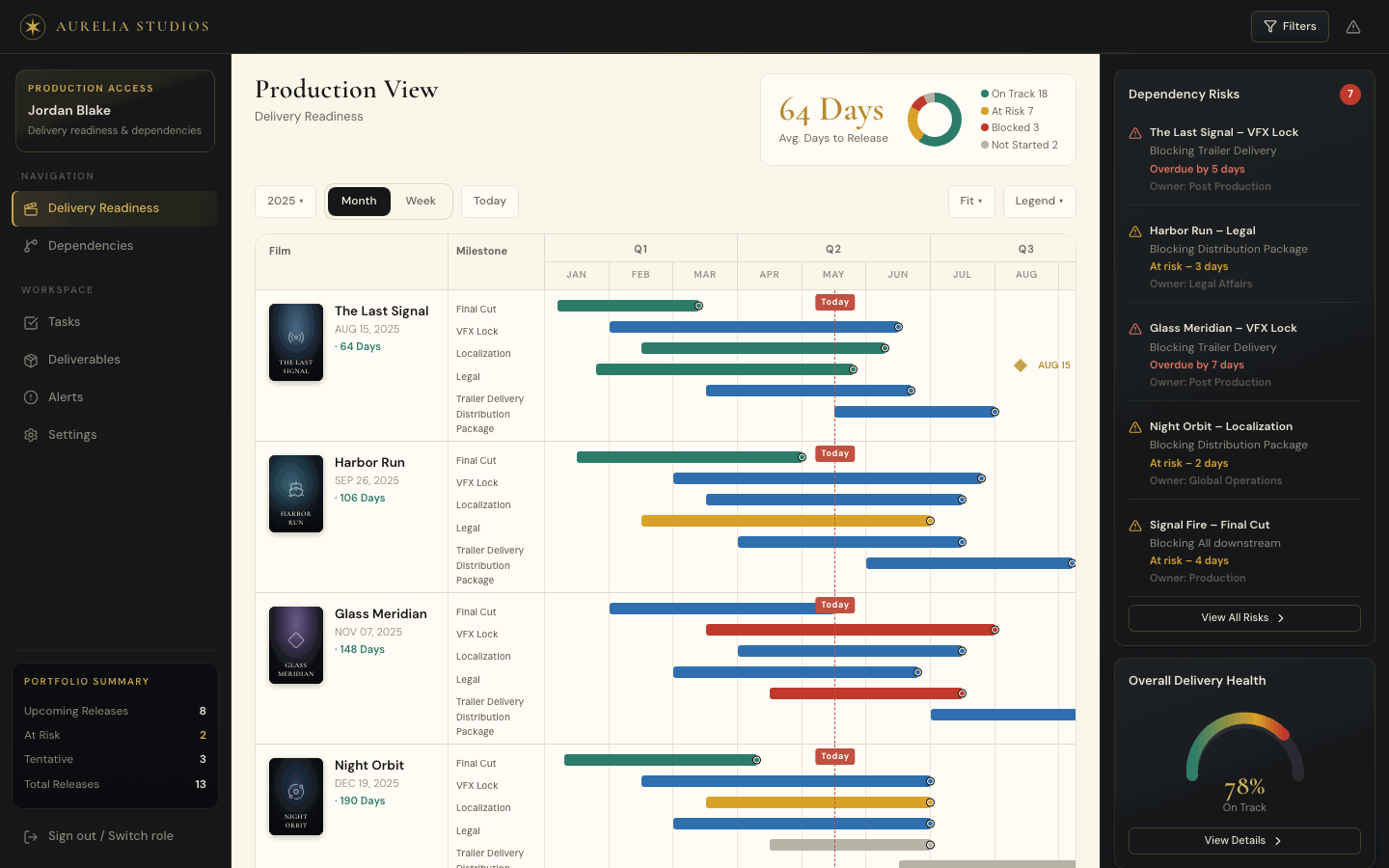
Shipped interfaceProduction delivery-readiness view: a milestone Gantt per film with dependency arrows, days-to-release, and a dependency-risk rail.
Fig. 04 · Production view · milestone Gantt with dependency risks
Role — Lead designer across discovery, IA, interaction strategy, prototyping, stakeholder alignment, and delivery handoff. Worked with two designers, a product owner, business analysts, engineers, and MGM stakeholders.
30 days  to ship
+50%  on-time release rate
+30%  competitive positioning
−12%  release-cycle time
+13%  release stability
3  role-based views, one system

Release planning is not only a calendar problem. For a studio, the release date is where many business questions converge — audience timing, competitive films, marketing windows, theater availability, financial forecasting, regional differences, and executive judgment.

The team didn’t need another static calendar. They needed a decision environment for people who plan releases from different angles.
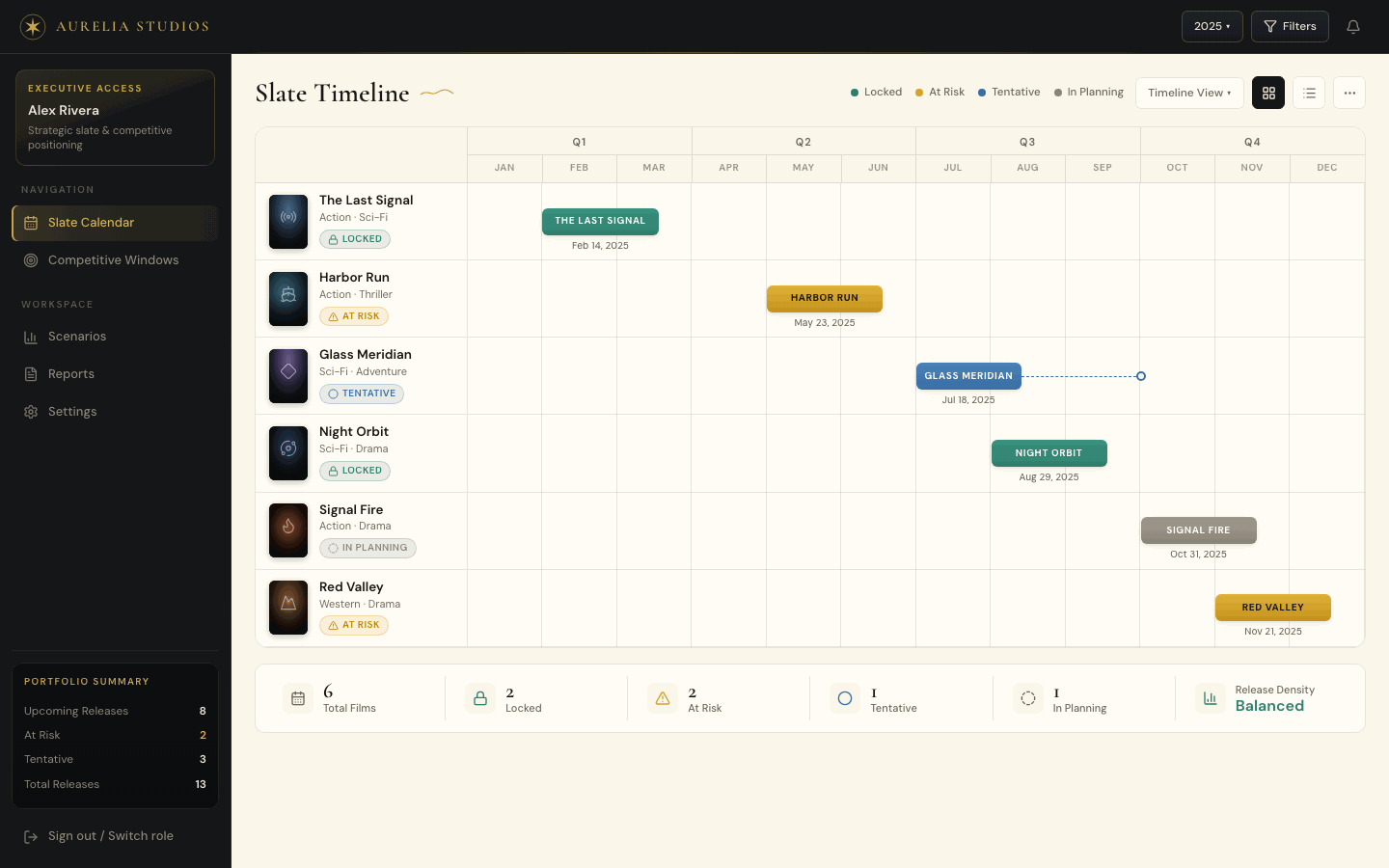
Client named with prior portfolio approval · metrics as delivered
Aurelia Studios slate timeline: six films across Q1–Q4 with locked, at-risk, tentative, and in-planning status bars and a portfolio summary.
Fig. 01 The slate timeline — the whole release calendar on one screen, colour-coded by status.
§ I
The problem

The same release object meant different things to each group.

Stakeholders used release information in fundamentally different ways. The challenge was one product model that could support multiple mental models.

Executive

Strategic view

Slate timing and competitive exposure across the whole release calendar.

Production

Operational control

Dates, changes, dependencies, and conflicts — the moving parts of delivery.

Marketing

Market context

Campaign timing, competitor noise, and audience signals behind each date.

Design
principle
Don’t force every role into the same calendar. Preserve one underlying release system, then shape views around decision context.One release. Different lenses.
§ II
Object model

One release system, made of shared objects.

The experience had to make these objects visible in different combinations depending on role and task — while the release itself stayed the spine.

Spine entity
Release
Every role view resolves to
relationships on this object.
is ofFilm object
targets · manyMarket object
occupiesWindow object
collides withCompetitive title signal
projected byForecast object
carriesStatus state
flagsRisk / conflict signal
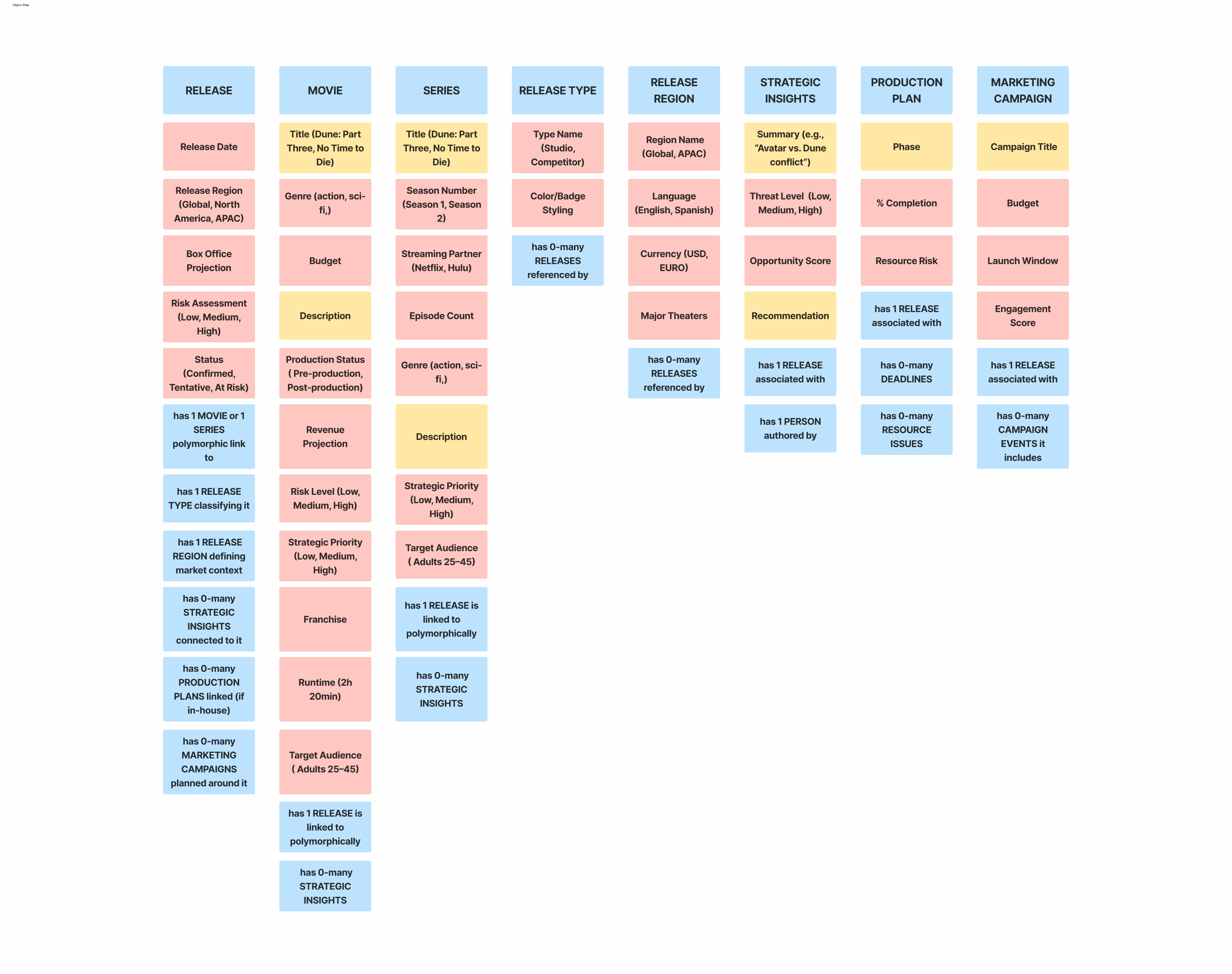
The object map · every object behind the release, and its attributes
OOUX object map for the MGM strategic release calendar: Release, Movie, Series, Release Type, Release Region, Strategic Insights, Production Plan, and Marketing Campaign with their attributes and relationships.
Fig. 02 The full object map — Release, Movie, Series, Release Type and Region, Strategic Insights, Production Plan, and Marketing Campaign, each with its attributes and relationships. Every role view is a different slice of this one model.
§ III
The three views

Designed around the decision each role had to make.

The product worked because it didn't assume every stakeholder needed the same view. The underlying object was the same release; the interface changed the lens.

Executive view

Confidence at the slate level

Slate, timing, exposure, and competitive risk — the strategic read.

Production view

Control at the operational level

Operational calendar, dependencies, release movement, and status.

Marketing view

Context to explain the date

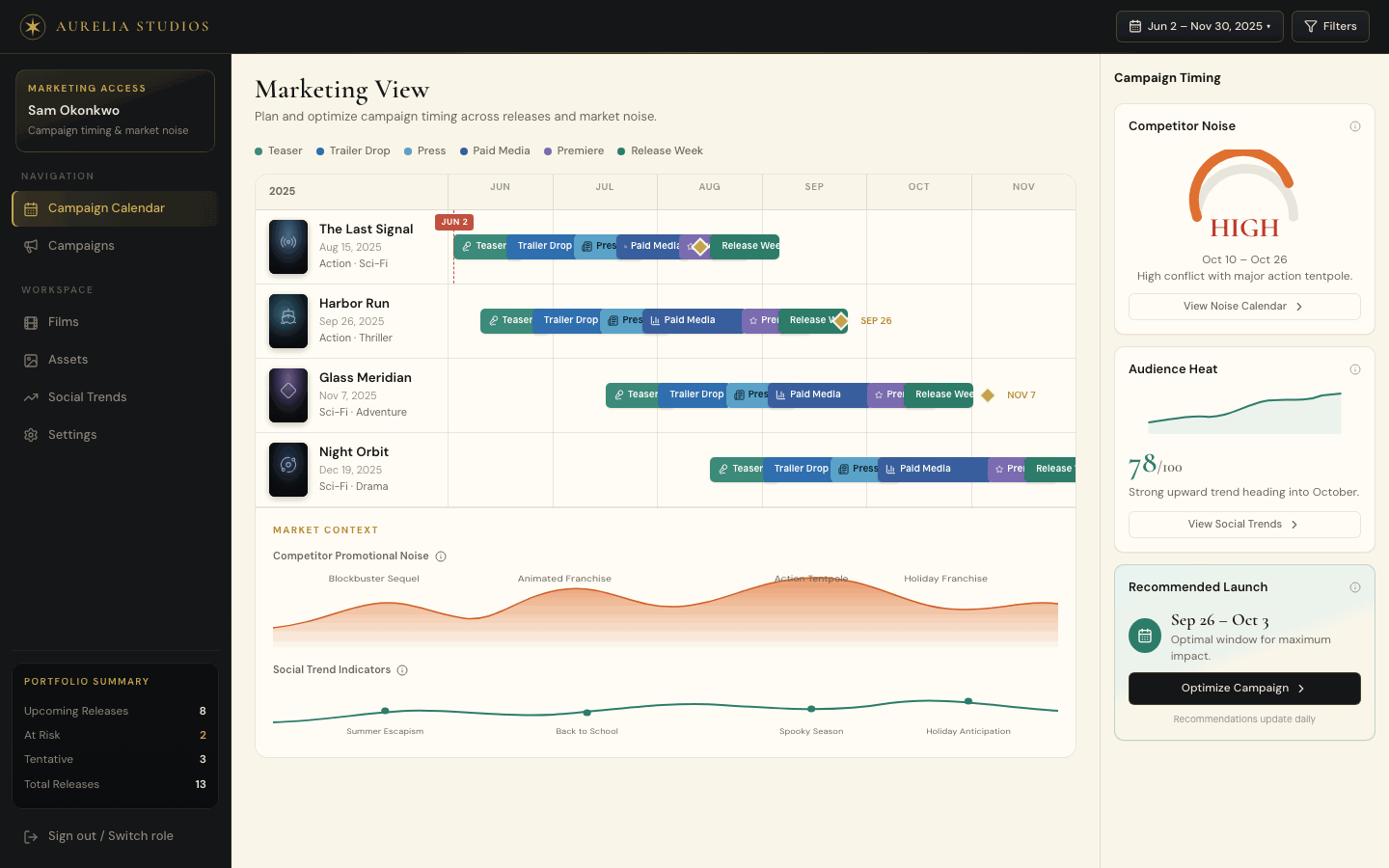
Campaign timing, competitor noise, and audience signals per release.
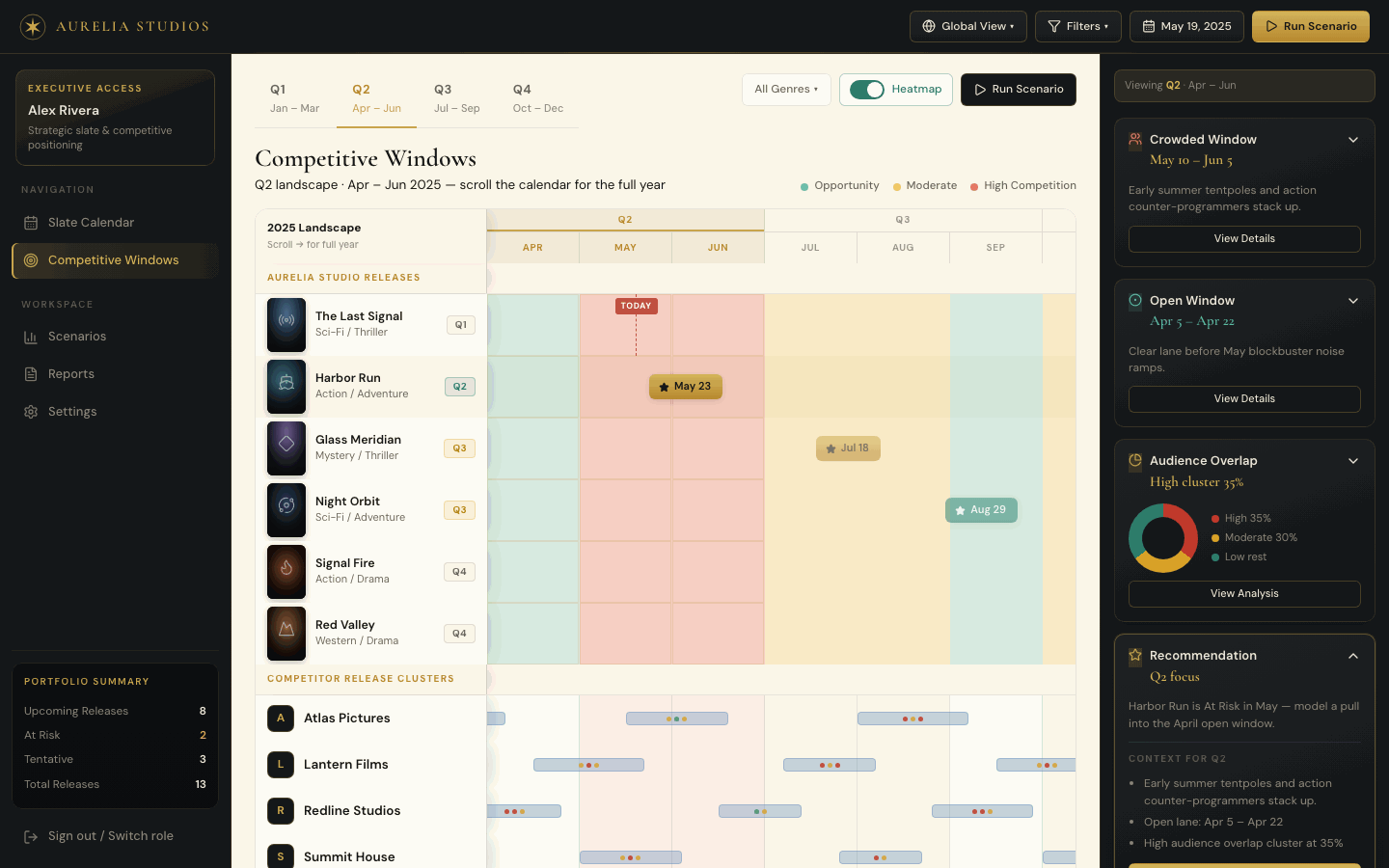
Executive competitive-windows view: our releases over a competition heatmap, competitor clusters, and an insight rail with crowded/open windows and a recommendation.
Fig. 03 Executive view — competitive windows and open-window signals
Marketing campaign-calendar view: campaign phase sequences per film over competitor promotional noise and social-trend charts, with a recommended-launch rail.
Fig. 05 Marketing view — campaign timing against market noise
§ IV
Key decisions

Complexity doesn’t disappear when you simplify the screen.

The work is deciding which complexity belongs to the system, which to the workflow, and which to the moment of decision.

Decision 01

Role-based views, not one overloaded master calendar

A single dense calendar would have looked comprehensive but felt unusable. We split the experience by how users made decisions, keeping the same release data underneath.

Implication — role-based navigation and filtering became central, not optional.
Decision 02

Treat conflicts as first-class signals

Planners needed to see when dates became risky — competitive collisions, crowded windows, missing dependencies, unstable changes.

Implication — conflict states and contextual markers surface without turning the calendar into noise.
Decision 03

Support strategy, not just scheduling

The business value came from better timing decisions, not cleaner date entry — so the interface connected releases to market and competitive context.

Implication — the calendar carries contextual layers, not only events.
Decision 04

Prototype fast enough to align senior stakeholders

On a compressed timeline, high-fidelity prototypes let stakeholders react to something concrete and helped the team converge on structure.

Implication — visual fidelity was a decision-making tool, not polish.
Decision 05

Design the handoff between role views

The roles differed, but the work was connected. A decision made in one view had to stay understandable in another.

Implication — shared objects and persistent statuses mattered more than page-by-page optimization.
§ V
Outcome

From fragmented planning to a shared strategic view.

The system improved coordination, reduced cycle time, increased stability, and helped stakeholders reason about competitive timing with more confidence.

On-time rate
+50%

Better visibility into slate, market, and conflict signals.

Positioning
+30%

Stronger competitive market-share timing decisions.

Cycle time
−12%

Release information consolidated into a role-aware workflow.

Stability
+13%

A domain translated into reusable views, states, and decision objects.

§ VI
Selected screens

Each lens, all the way down to the detail.

Every role view drills into a detail screen designed around that role's decision — the same release object, a different depth of read.
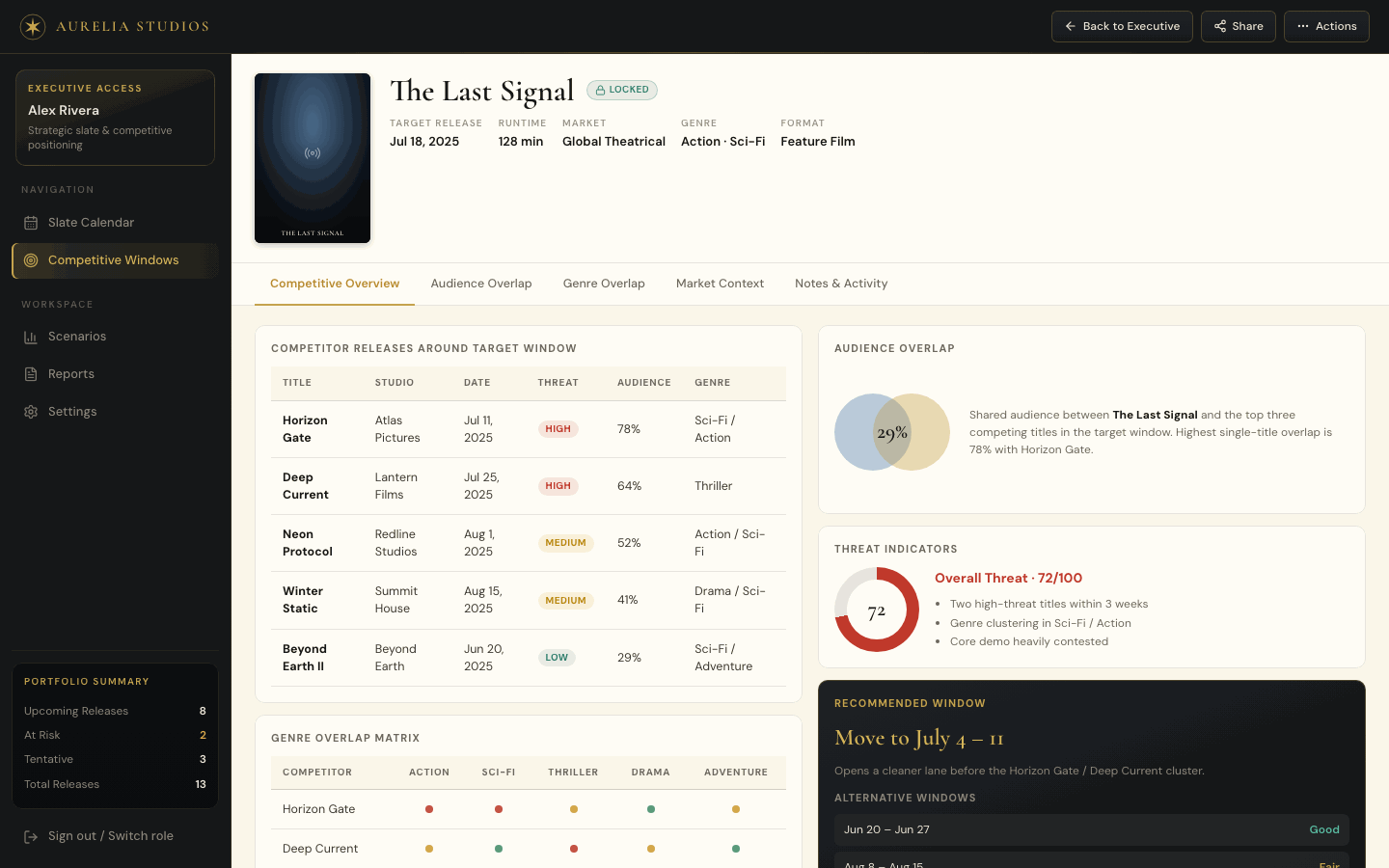
Executive competitive detail for a film: competitor releases around the window, audience overlap, genre-overlap matrix, threat indicators, and a recommended window.
Fig. 06 Competitive detail — a title's threat landscape and recommended window
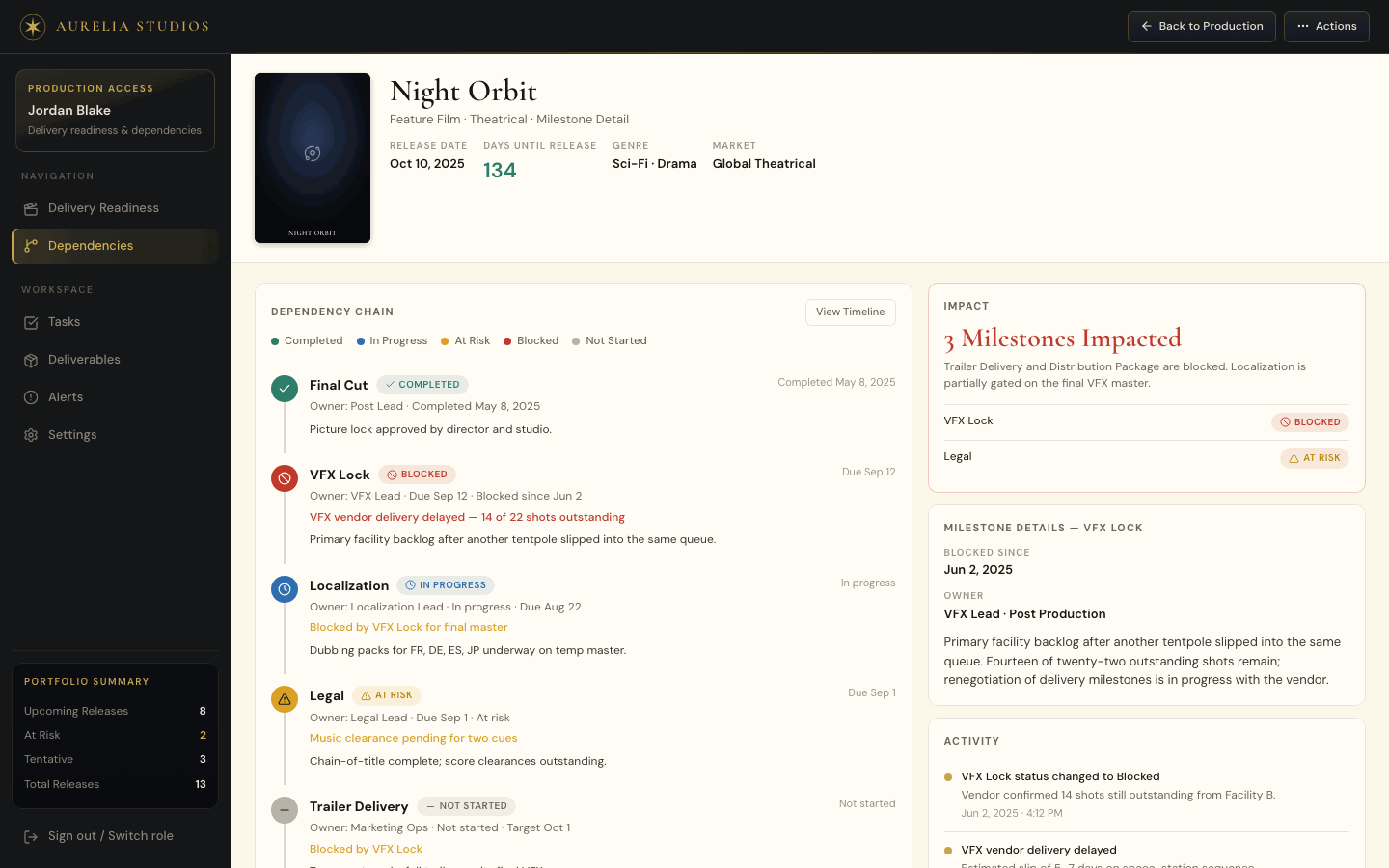
Production milestone detail: a film's dependency chain (final cut, VFX lock, localization, legal, trailer, distribution) with owners, statuses, blocked reasons, and impact.
Fig. 07 Milestone detail — the dependency chain and what a slip cascades into
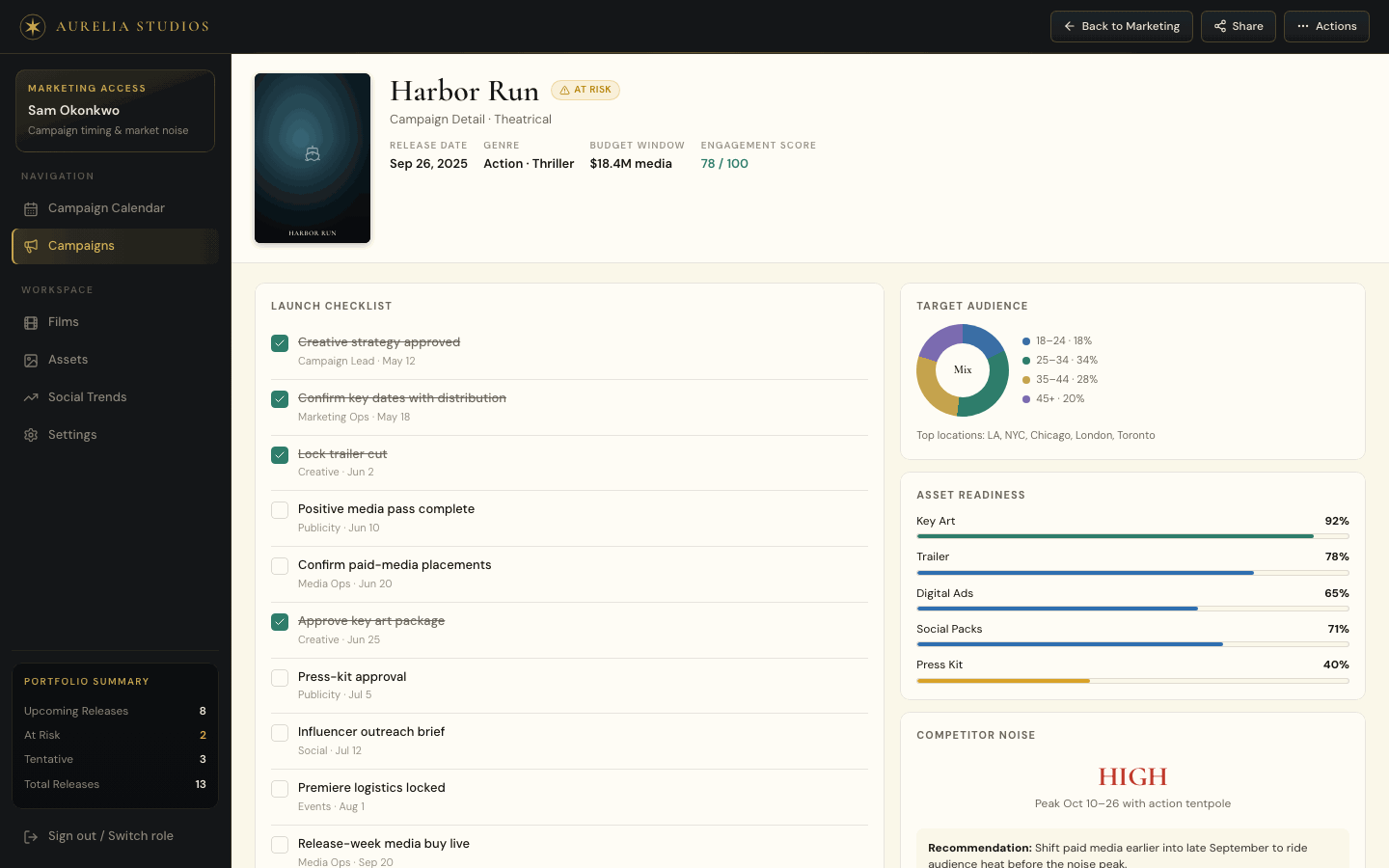
Marketing campaign detail for a film: launch checklist, media calendar, target-audience mix, asset readiness, competitor noise, and a recommendation.
Fig. 08 Campaign detail — launch checklist, media calendar, and audience mix
§ VII
More of the system

A calendar was the surface. Underneath was a whole operating system.

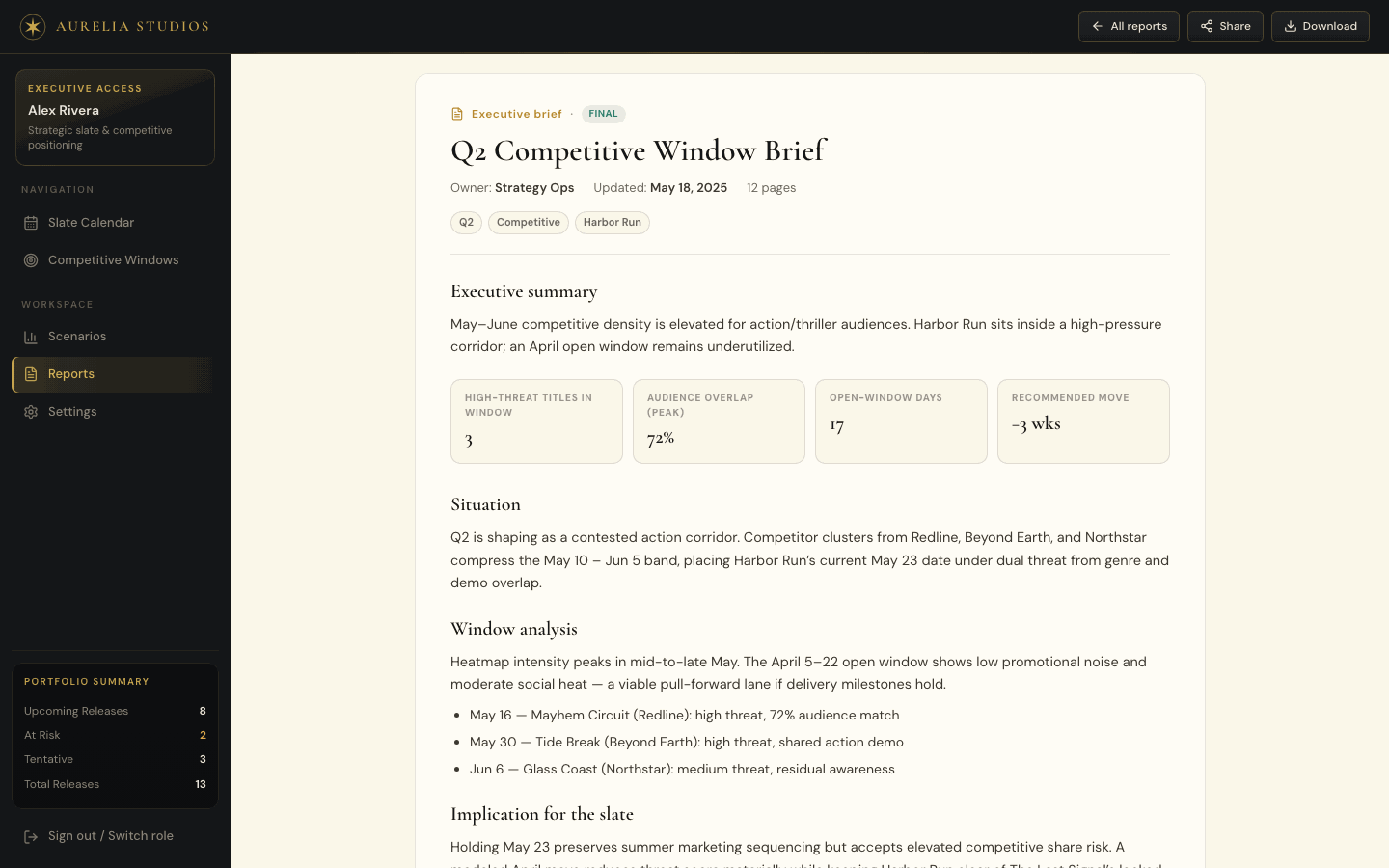
Scenario planning, reporting, task management, alerts, a film catalog, and market-signal tracking — the supporting surfaces each role actually works in.
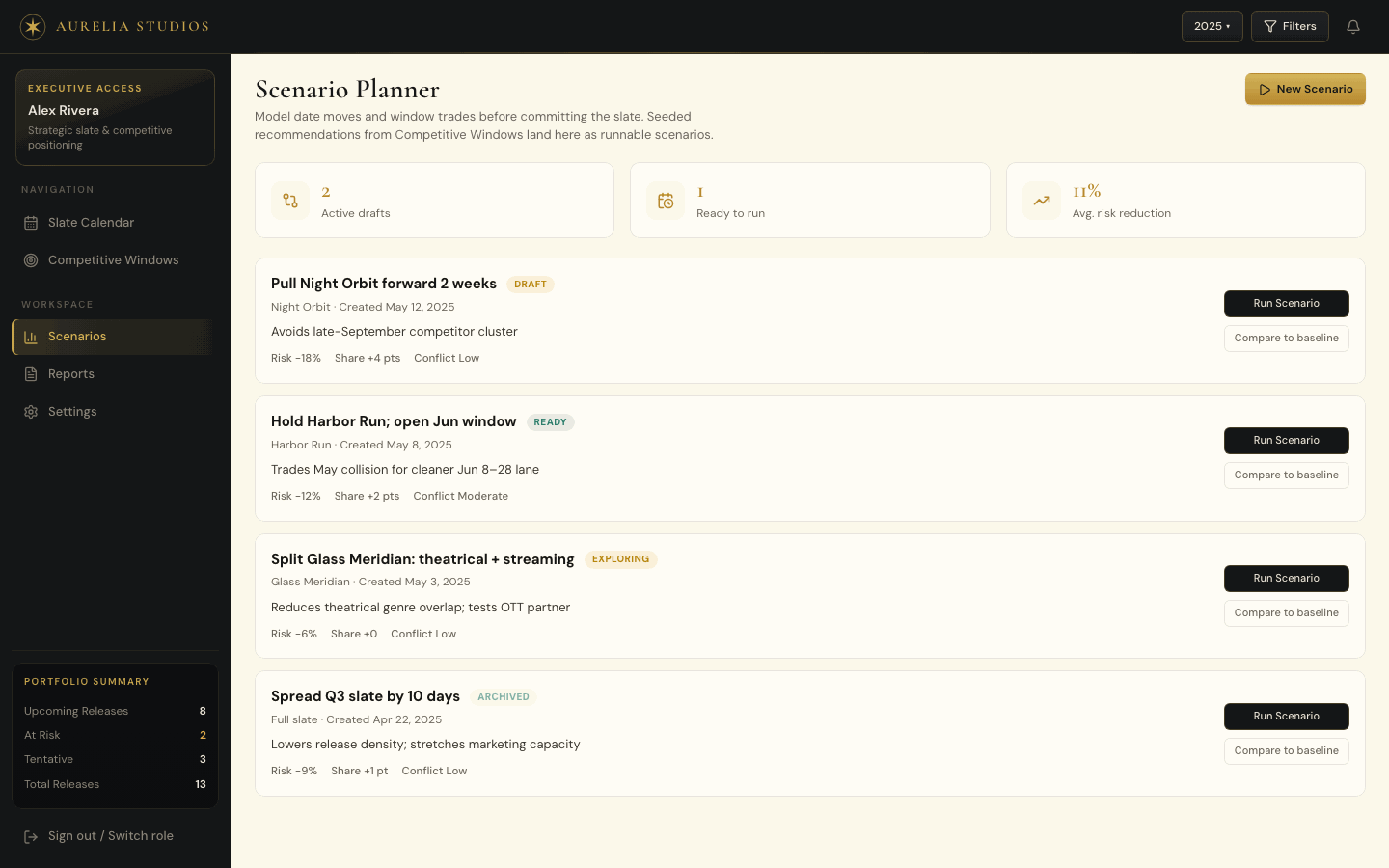
Executive scenario planner: proposed date moves with competitive-window impact and run-scenario actions.
Fig. 09 Scenario planner — model a date move before committing it
A generated Q2 competitive window brief document: executive summary, situation, window analysis, and implication.
Fig. 10 Competitive brief — a shareable strategic read
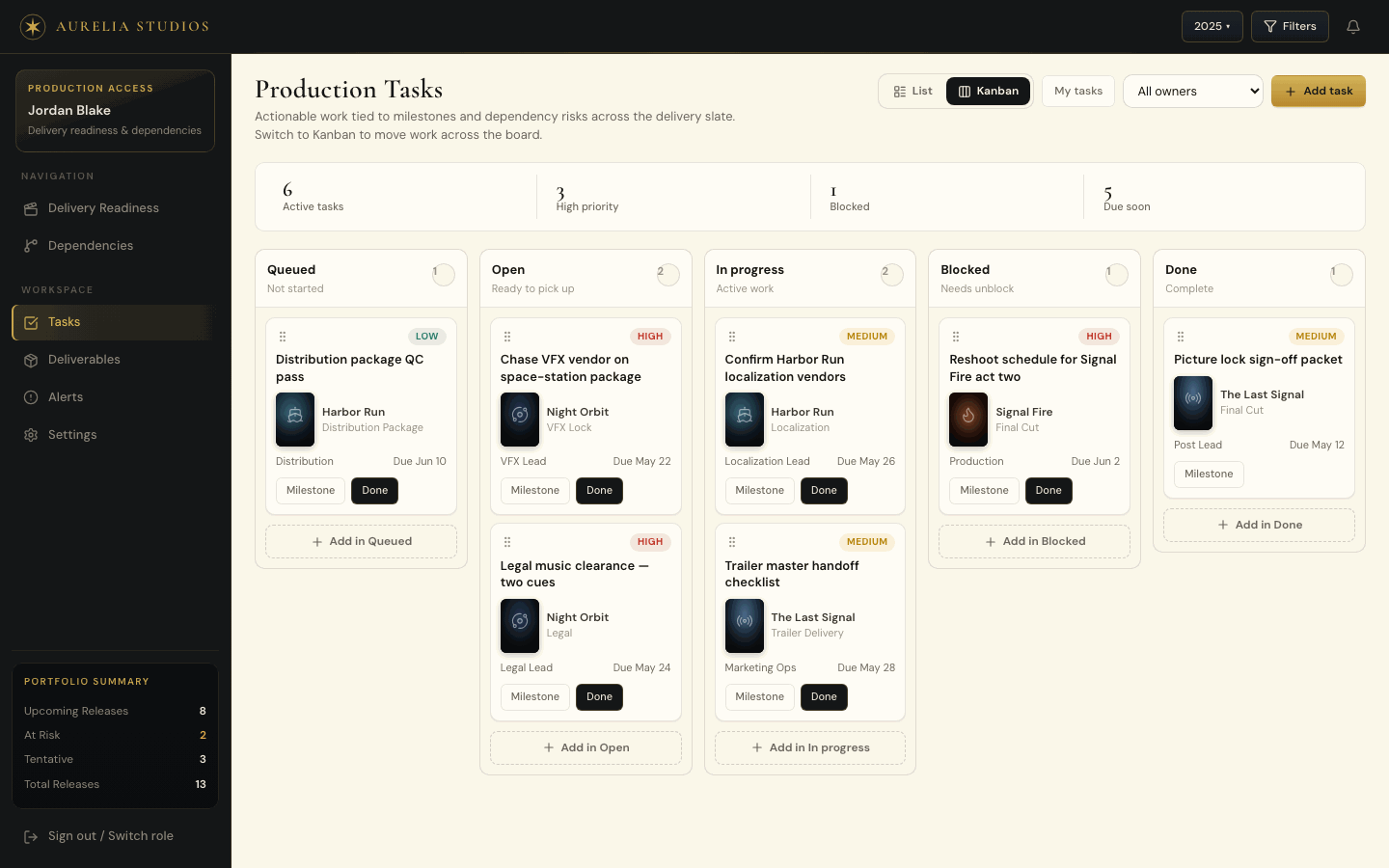
Production tasks kanban board: queued, open, in-progress, blocked, and done columns of delivery tasks.
Fig. 11 Production tasks — kanban across delivery states
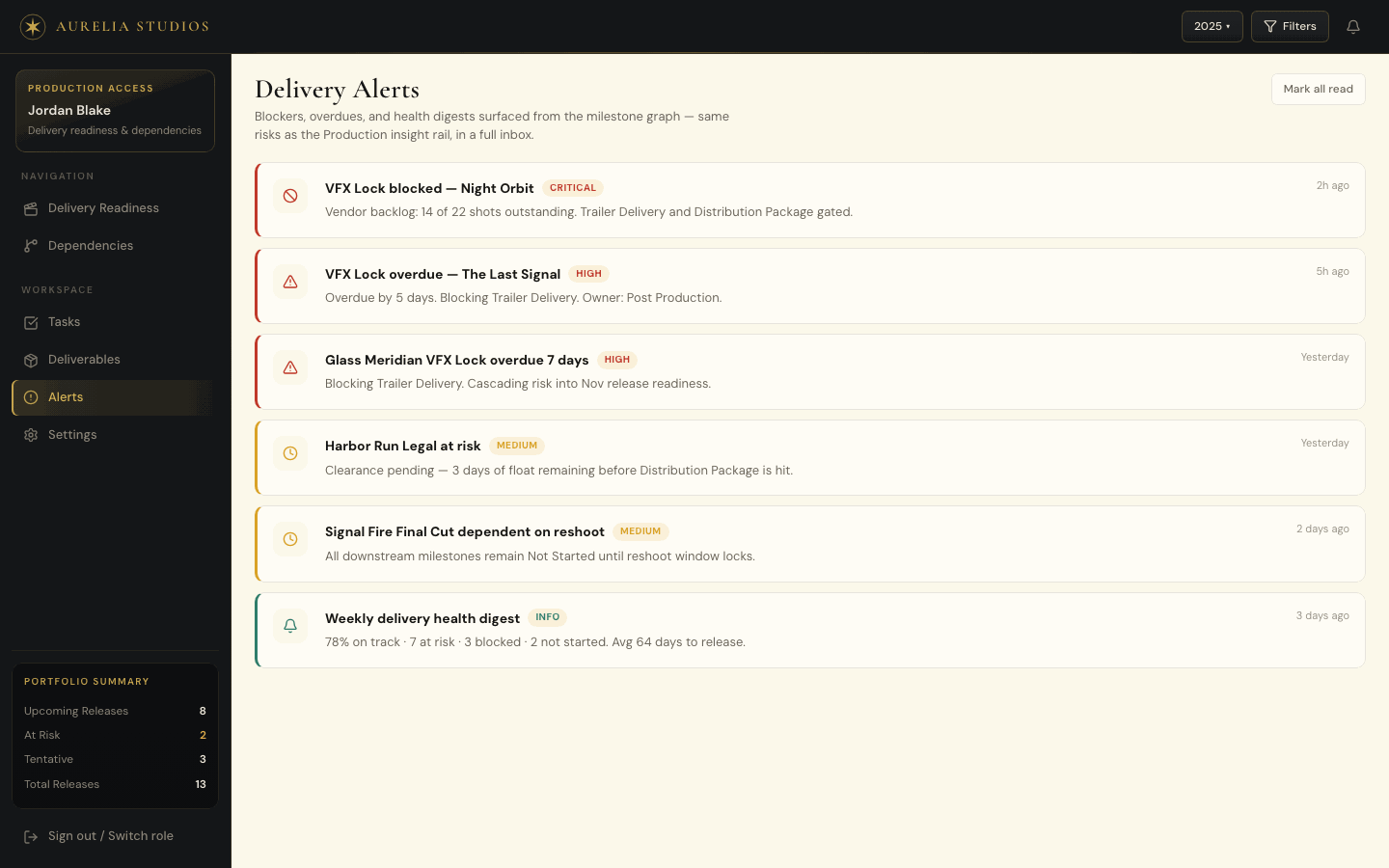
Production delivery alerts: overdue and at-risk milestones flagged with severity, owner, and days to release.
Fig. 12 Delivery alerts — early warnings straight from the timeline
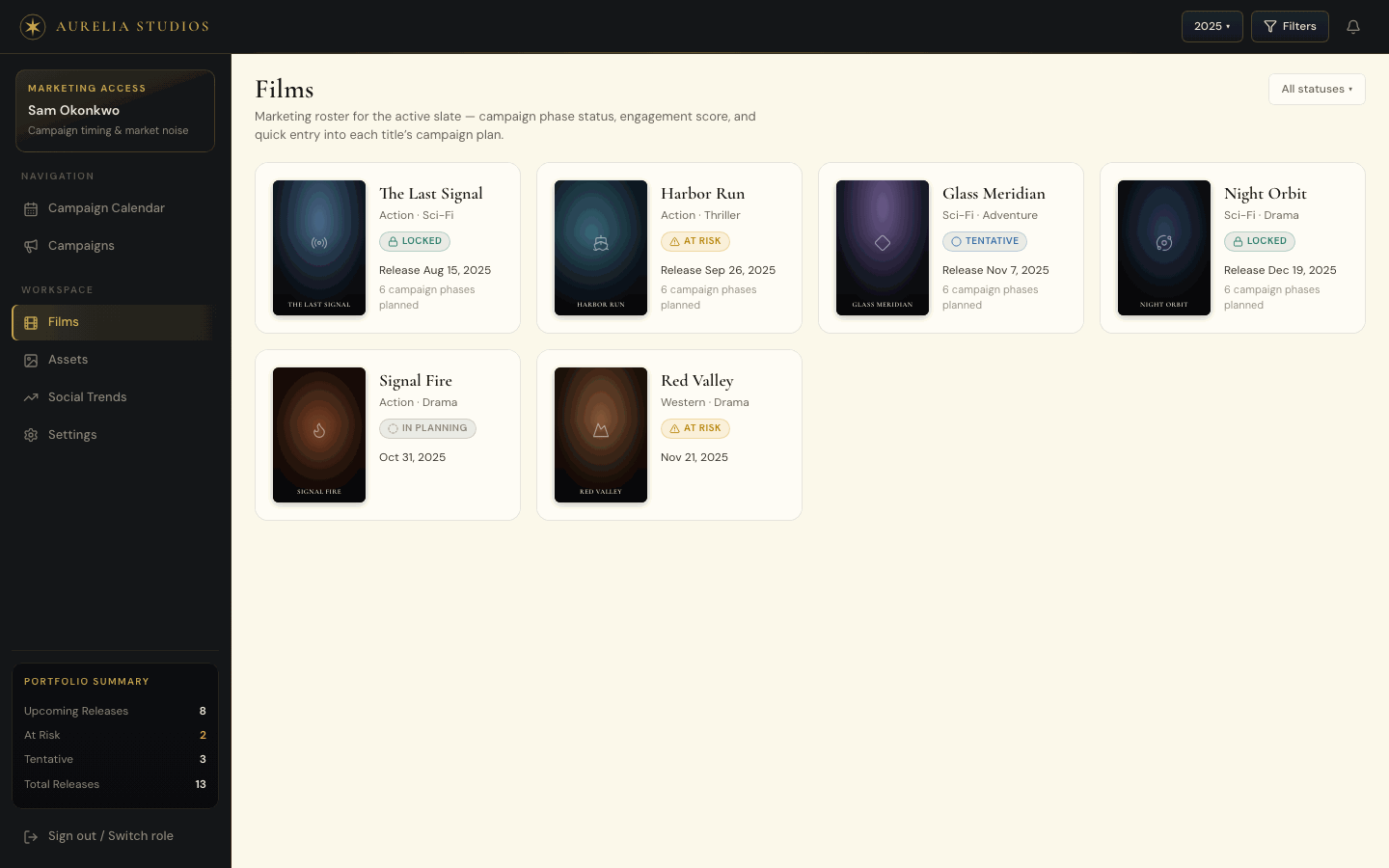
Marketing films catalog: the full slate as poster cards with genre, release date, and status.
Fig. 13 Film catalog — every title and its release status
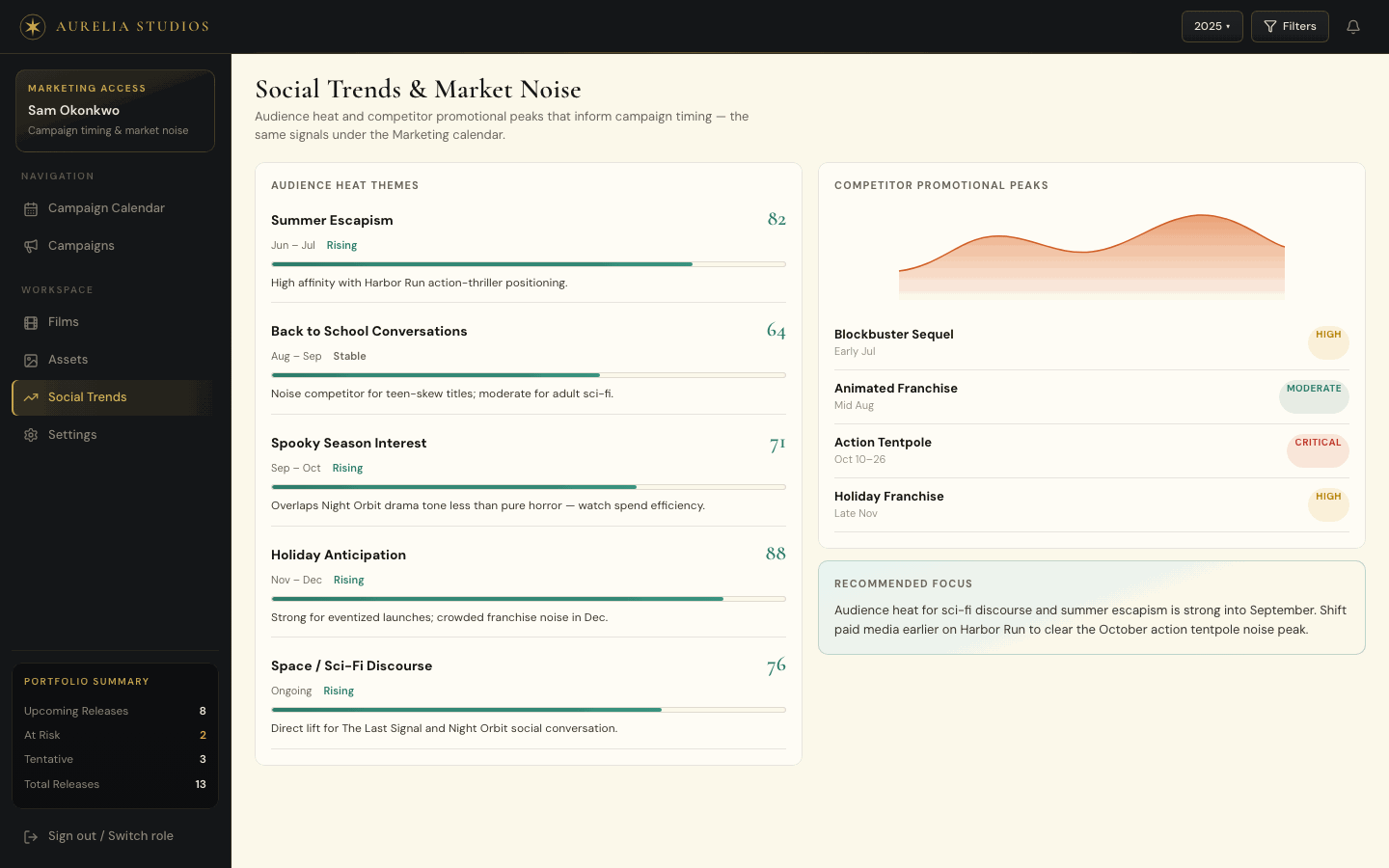
Marketing social trends and market noise: audience-trend indicators and competitor promotional-noise charts.
Fig. 14 Social trends & market noise — the signals behind timing
Closing
reflection
For MGM, the answer was not one perfect calendar. It was one release system with different decision lenses.Complexity you don't remove — you place it where it belongs.